By His Eminence Metropolitan Cleopas of Sweden
Human experience, across all cultures and in every age, has associated two elements with the very core of life and salvation: light and water. Without light there is no vision, orientation, or knowledge; without water there is no life, purity, or renewal.
It is therefore no coincidence that these two elements appear consistently both in the great religious narratives and in the ritual and philosophical traditions of humanity.
The Church, in the Great Feast of Theophany, does not employ them merely as poetic images. It reveals them as loci of divine presence. At Theophany, light and water do not simply symbolize salvation; they manifest it.
Correspondingly, in ancient Greek thought and worship, light and water constitute fundamental means for understanding the world, knowledge, purification, and the relationship between humanity and the divine.
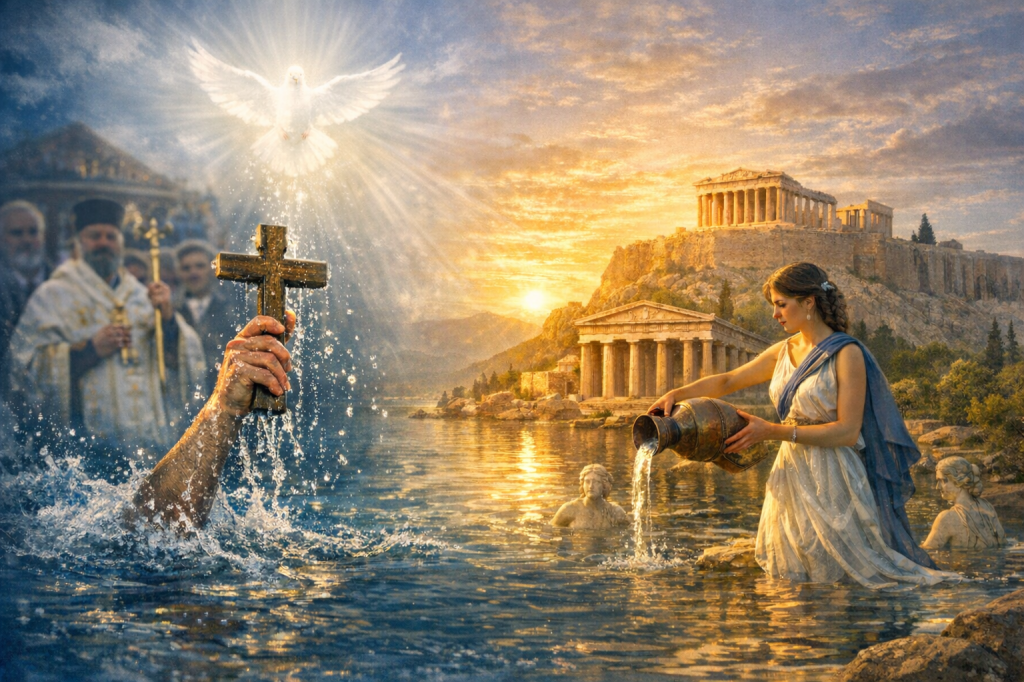
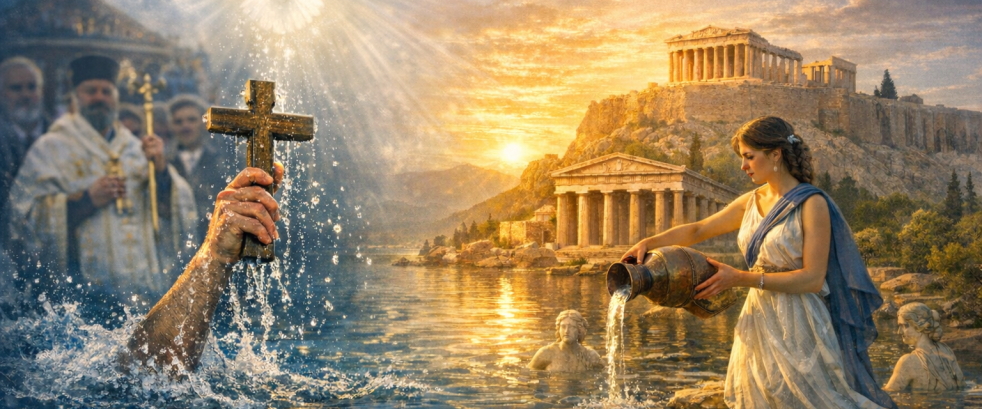
The Feast of Theophany is a culminating moment in the church life, because it does not merely commemorate an event in the earthly life of Christ, but celebrates the very manifestation of God within history: the revelation of the Holy Trinity and the foundation of humanity’s salvific journey.
In the River Jordan the Triune God is revealed. The Son is baptized, the Holy Spirit descends “in the form of a dove,” and the voice of the Father bears witness to the sonship of Christ: “This is My beloved Son.”
At Theophany, the Church does not simply celebrate the Baptism of Christ as a biographical event, but as a cosmic turning point. God is revealed publicly and salvifically.
The Church calls this feast “Lights,” not in a metaphorical or poetic sense, but because here the true, uncreated Light of God is revealed, entering the world to dispel the darkness of corruption and estrangement from the Creator.
At Theophany this victory begins as manifestation and sanctification. At Pascha it is consummated as victory over death. The feasts are distinct, yet theologically convergent: the same Light that “appears” in the Jordan “triumphs” in the Tomb!
The hymnography of the day is unequivocal. The apolytikion of Theophany proclaims: “When You were baptized in the Jordan, O Lord, the worship of the Trinity was made manifest.” The manifestation of God is inseparably linked with water. The Jordan is not merely a place; it is a boundary where light enters matter and transforms it.
With unparalleled theological density, the Church chants in the Great Blessing of the Waters: “Today the nature of the waters is sanctified.” Water does not merely signify purity, as in ancient rites of cleansing. It changes state. It is illumined. It is sanctified. It becomes a bearer of life.
Liturgical tradition thus condenses the ontological dimension of Theophany. Christ “sanctifies the nature of the waters” so as to open the path to rebirth “through water and the Spirit.”
Here, the “victory of light” does not concern only the inner life of the human person. It concerns creation itself. Water—and through it matter—becomes a bearer of sanctification, not merely a ritual symbol.
The Fathers of the Church approached Theophany with exceptional theological depth. Saint Gregory the Theologian, in his celebrated oration On the Holy Lights, presents the Baptism of Christ as an act of renewal of the whole creation.
According to Saint Gregory, Christ is baptized not to be purified, but to purify; He does not approach the waters as a sinner, but as God who enters the element of water in order to transform it into an instrument of salvation.
Light and water are united: the light of divinity sanctifies the water, and through it humanity is offered the possibility of new life. The victory of light over darkness is not merely moral or epistemological; it is ontological, because it concerns human nature and existence itself.
At Theophany, Saint John Chrysostom highlights the wisdom of the divine economy. In his homilies on the Baptism of Christ, he emphasizes that God reveals Himself not through coercion, but through humility. The light of Theophany does not blind; it illuminates pedagogically, leading the human person to a free acceptance of truth. Christ comes to baptism not as one in need of cleansing, but to lead humanity to salvation and to reveal the magnitude of divine condescension.
Water becomes the sign of this pedagogy. A simple, everyday element, it acquires salvific power through divine presence.
Saint Basil the Great, linking light with the Holy Spirit, underscores that true illumination is not the product of rational effort, but the fruit of participation in divine energy. “In Your light we shall see light,” he notes, showing that light is not merely an object of vision, but a mode of existence. Victory, therefore, is not self-generated clarity, but participation in divine energy and knowledge bestowed “in the Spirit.”
Thus, in patristic thought: a) Theophany reveals the Triune God; b) Light is salvific, aiming at the healing of corruption and sin; c) Light is ecclesiological and sacramental, culminating in the “illumination” of Baptism; d) Light is cosmic, in the sense of creation, since the sanctification of the waters signifies the renewal of the world.
The water of Baptism becomes the place of rebirth and a new beginning. Hence, at Theophany, light and water constitute a single theological reality; light that sanctifies, water that illumines.
Human beings truly see only when they dwell within the light of God; for this reason Baptism was called “Illumination” by the ancient Church.
Turning now to ancient Greece, we find that the same elements—light and water—occupy a central place, though with a different semantic content. In antiquity, three principal spheres of meaning for “light” can be discerned: epistemology, initiation, and the polis/city.
In Greek philosophy, light is directly linked to truth and knowledge. In Plato’s “Republic,” light is conceived as the condition of truth; a cognitive victory over darkness. The famous allegory of the cave depicts the human being emerging from the darkness of shadows into the light of truth.
The ascent from the cave symbolizes the transition from opinion to truth. Truth is associated with what is manifest and unconcealed, with light as the condition for the visibility of reality.
Here, the “victory of light” signifies the victory of intellect over confusion. It is an argument for reason and education. Light is not divine presence, but the condition of the possibility of knowledge. The victory of light means the triumph of reason over error, of education over ignorance.
The allegory of the cave describes a dramatic movement. The victory of light is primarily epistemological and pedagogical: humanity is “saved,” in a Platonic sense, when it turns its gaze toward what truly is and endures the light of truth.
In Plato, light is the horizon of intellectual conversion; at Theophany, it is divine manifestation itself, which precedes human movement and makes it possible.
In the religious practice of ancient Greece, light acquires a ritual dimension. In the Homeric Hymn to Demeter, the goddess searches for Persephone holding lit torches in the night. Light becomes a symbol of hope amid the darkness of loss and mourning.
The motif is powerful: darkness equals loss and grief; light equals search and hope. The torch is not merely a practical tool; it is ritual language, declaring that life resists the night.
At Theophany, “search” is not central; finding is. God Himself approaches and reveals Himself.
In the Eleusinian Mysteries, the transition from darkness to light forms the core of the initiatory experience. Through ritual acts, the initiate undergoes an existential transformation. Light does not reveal a person, but promises a new stance toward life and death. The initiate “sees” light as the unveiling of hidden truth.
In Eleusis, the motif “darkness → light” serves the experience of initiation: participation in a rite that promises a changed attitude toward death and life. Crucially, this change does not depend on a historical divine action, but on ritual access and inner experience.
In Eleusis, light functions as a ritual bearer of experiential initiation; at Theophany, it is linked to a historical divine act—the Baptism of Christ—and to a church Sacrament (illumination/baptism) offered universally.
In antiquity, light functions as both cosmic and divine element. It is associated with deities such as Apollo (light, measure, harmony, prophetic purity) and Helios/Sun (solar deity and cosmic visibility), and more broadly with the idea that light is a bearer of order. It signifies the harmony of nature and the regularity of the cosmos—the opposite of chaos.
Light also functions as moral and political illumination: education and the polis/city. As a cultural value, it signifies transparency, measure, avoidance of hubris, education as the “illumination” of the citizen, and the ordering of the city.
Here, the victory of light is the victory of measure over disorder, of civilization over barbarism, of reason over irrationality.
The torch race preceding the Panathenaic procession exemplifies this public dimension. The light that must not be extinguished signifies continuity, order, collective memory, public glory, and civic cohesion.
The Orthodox Church transfers light from “public glory” to communion in sanctification. Light is not a prize; it is a gift.
In ancient Greece, darkness appears primarily as ignorance or error (the shadows of Plato’s cave), mourning and loss (Demeter in the night), or existential anxiety treated through ritual. Victory thus means education, initiation, restoration of order, and overcoming fear.
At Theophany, darkness is deeper and ontological: estrangement from God, corruption of existence, the need for rebirth “through water and the Spirit.” “Victory” is therefore not limited to knowledge or experience; it is sanctification, new life, participation in the light of God.
Here lies a crucial bridge and boundary between “initiation/mystagogy” and “sacrament.” Ancient Greece possesses forms of initiation: transition, purification, light as the climax of experience. The Church speaks of mystery; not merely a human ritual path, but divine energy acting truly in creation through the sanctification of the waters and in the human person as personal, inner illumination. Theophany proclaims that the Light has come, has been revealed, and sanctifies.
In ancient Greece, light is a supreme cultural symbol organizing knowledge (Plato), ritual (Demeter/Eleusis), and the city (Panathenaea). At Theophany, light is divine manifestation itself and the sanctification that transforms creation and humanity. Victory is not merely an exit from ignorance, but entry into new life “through water and the Spirit.”
Christianity and ancient Greece share a common anthropological foundation. Humanity perceives light as life and security, darkness as threat and ignorance, and transition to light as liberation, knowledge, and rebirth. Hence “feasts of light” are universal, expressing the human longing to overcome darkness.
At Theophany, light is: a) personal—Christ Himself is the Light; b) historical—the manifestation occurs in a specific time and place; c) salvific and ontological—it concerns not only knowledge or emotional uplift, but the healing of corruption and restored communion with God.
In ancient Greece, light is often: a) cosmological (order of the universe); b) epistemological (truth as manifestation); c) ritual (initiation through symbols); d) moral and political (measure and education).
In other words, Greek tradition seeks light as humanity’s ascent toward truth. Theophany proclaims light as God’s descent toward humanity.
In Greek thought, victory is primarily the victory of knowledge or culture. In Christian faith, victory is the victory of grace over corruption and estrangement, with the ultimate horizon being the transcendence of death.
Water in ancient Greece is likewise closely associated with purification. It lacks a salvific character and functions as an element of natural life and ritual cleansing. Water cleanses defilement and permits approach to the divine, yet remains symbolic. It is not sanctified in itself and does not ontologically transform the human person. The relationship between humanity and the divine remains largely ritual and cosmological.
Comparison with Theophany reveals both continuity and radical rupture. In both traditions, light and water are linked to the overcoming of darkness, disorder, and threat. In ancient Greece, this overcoming is achieved through knowledge, initiation, or ritual purification. At Theophany, it proceeds from God’s own entry into the world. Light is not discovered; it is revealed. Water does not merely signify purity; it is sanctified and becomes a bearer of divine life.
The “victory of light over darkness” at Theophany, therefore, is not simply the victory of knowledge over ignorance, as in Plato, nor of hope over fear, as in the Eleusinian Mysteries. It is the victory of life over corruption, communion over estrangement, divine presence over human loneliness.
The light of Theophany illumines humanity not merely to see, but to live; and the sanctified water does not merely cleanse, but regenerates.
Thus we may say that ancient Greece prepared, at the level of cultural symbols, the profound human expectation for light and purity. Theophany, however, grants this expectation its fullness. Light and water are no longer merely paths of search, but places of encounter with God.
Where people once lit torches in the night, the Church confesses that the Light has come; and where water once cleansed externally, the Church bears witness that the water is sanctified and becomes a source of eternal life!
 Ελληνική Ορθόδοξη Ενορία Αγίου Ανδρέα Μάλμε