By His Eminence Metropolitan Cleopas of Sweden
The Orthodox Church, within her Spirit-filled treasury, has throughout the ages brought forth radiant figures who were not merely theologians, but living exemplars of faith, love, and ministry.
The Church is not founded upon ideas or philosophical systems, but upon sanctified persons who became “living icons” of the Gospel.
One of the foremost and most universal figures of the Patristic Tradition is Saint Basil the Great, Bishop of Caesarea; a pillar of Orthodoxy, teacher of the Church, theologian of truth, shepherd of souls, and father of the poor.

Saint Basil uniquely united rare intellectual acuity with profound spiritual humility. Endowed with exceptional education, he studied in Caesarea, Constantinople, and Athens, where he distinguished himself by his wide learning in philosophy, rhetoric, and the sciences. Yet he never regarded knowledge as an end in itself, but as an instrument in the service of the truth of the Gospel.
His ascetic life—his self-control, renunciation of possessions, and unceasing prayer—made him a living model of a bishop and shepherd who first lived what he taught. He himself writes characteristically: “All human wisdom became vanity to me when the light of the Gospel shone within my soul.” (Epistle 223)
The literary work of Saint Basil is vast in scope and invaluable in theological significance. Of particular importance are his dogmatic writings, foremost among them On the Holy Spirit, in which he establishes with precision and clarity the divinity of the Holy Spirit, contributing decisively to the formation of the Church’s Trinitarian doctrine.
He writes: “We do not call the Holy Spirit a creature, nor a servant, but consubstantial with the Father and the Son.”
Equally significant are his homilies on the Hexaemeron, where, interpreting the Book of Genesis, he combines theological reflection with observations on nature and creation, demonstrating that faith does not oppose reason, but transcends it and illumines it. Teaching about creation, he emphasizes: “Marvel at the Creator through His creations; from what is visible ascend to the Invisible, and from the created things conceive the Creator.”
Saint Photius the Great would later say of him: “Basil is the rule of Orthodoxy and the precision of dogma.”
His letters, pastoral and theological, reveal a man of deep sensitivity, who struggles for the unity of the Church, confronting heresies, administrative difficulties, and human weaknesses with discernment and love.
Of particular and enduring significance is Saint Basil’s contribution to the liturgical life of the Church through the Divine Liturgy that bears his name. The Divine Liturgy of Saint Basil the Great, celebrated to this day on specific days of the ecclesiastical year, is distinguished by the depth of its prayers, its strongly dogmatic and soteriological character, and the majesty of its theological language.
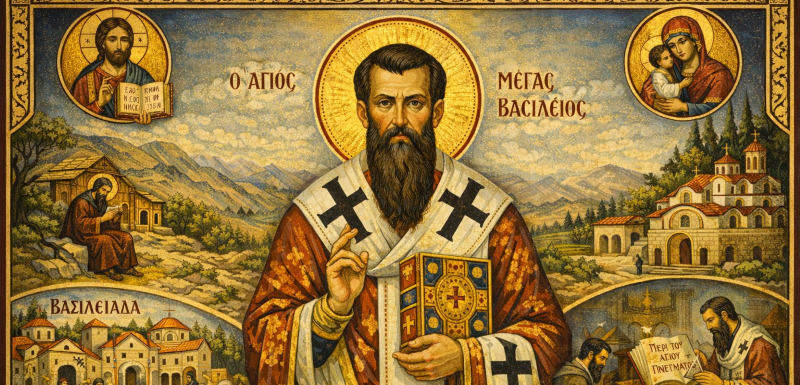
The philanthropy of Saint Basil was not theoretical, but practical. Its supreme example is the renowned Basileias, an unprecedented social complex for its time, which included hospitals, poorhouses, guesthouses, and facilities for the care of lepers and the sick. There, the love of Christ became daily action, proving that the Church exists not only to teach, but also to heal, to console, and to save.
The homilies of Saint Basil possess a strong pastoral and social character. His word is bold, prophetic, and reproving toward social injustice and indifference to the suffering neighbor.
In one of his social discourses he states with frankness: “He who exploits others commits injustice; the rich man who does not share is a robber.” And elsewhere: “You are holding back the bread of the hungry; you are keeping the garment of the naked.” He himself teaches: “Nothing is so characteristic of a Christian as showing mercy.”
Saint Gregory the Theologian describes the Basileias as: “A new city, a treasury of love for the poor, a healing place for diseases, and a refuge for suffering.”
The great Fathers of the Church spoke with admiration of Saint Basil. Saint Gregory the Theologian, his close friend, presents him as a “pillar of virtue” and a “rule for bishops,” emphasizing that in his person contemplation and action were united. Praising him, he notes: “For him, word was action and action was word; true philosophy—not in the shadow of words, but in the exactness of virtue.” (Funeral Oration for Basil)
Saint John Chrysostom praises his courage before authority and his unwavering stance for Orthodoxy, even when this meant persecutions and threats: “He was not a man who accommodated himself to the times, but one who served the truth.”
Saint Basil the Great does not belong only to the past of the Church, but also to Her present and Her future. His example calls us to unite right faith with active love, theological knowledge with humility, worship with service to our neighbor.
He exhorts us to become theologians not only with our lips, but with our hearts and our deeds. He reminds us that right faith without love becomes lifeless, and love without truth loses its direction.
As a true Father of the Church, he continues to beget spiritual children through his work and his timeless witness.
May we, through the intercessions of Saint Basil the Great, be found worthy to live the Gospel—not merely in words, but as lived experience—for his memory is indeed a call to imitation!
 Ελληνική Ορθόδοξη Ενορία Αγίου Ανδρέα Μάλμε